Chief Data Officers Council
"Building on our shared belief that data is foundational to everything government does, the Chief Data Officers community stands ready to support implementation of the President's Management Agenda. Across agencies, we have strengthened data governance, improved data quality, and advanced the use of data as a strategic asset to enable more effective, data-driven decision-making.
This foundation allows us to accelerate key priorities, including responsible Artificial Intelligence adoption, Zero Trust implementation, and the expansion of open data. Through collaboration and shared leadership, the CDO Council is committed to translating trusted, high-quality data into better decisions, stronger security, and improved services for the American public."
—Kirsten Dalboe, Chair
Authority
The CDO Council was established by statute in the Foundations for Evidence-Based Policymaking Act of 2018 (P.L. 115-435) 44 USC § 3520A (opens in a new tab) (Evidence Act) and extended in M-25-06 Re-establishing the Chief Data Officer Council (opens in a new tab). It serves as a forum to:
- establish government-wide best practices for the use, protection, dissemination, and generation of data;
- promote and encourage data sharing agreements between agencies;
- identify ways in which agencies can improve upon the production of evidence for use in policymaking;
- consult with the public and engage with private users of Government data and other stakeholders on how to improve access to data assets of the Federal Government; and
- identify and evaluate new technology solutions for improving the collection and use of data.
Charter
In September 2025, the CDO Council updated its Charter which can be found here (opens in a new tab).
Vision
The Council's vision is to improve government mission achievement and increase the benefits to the Nation through improvement in the management, use, protection, dissemination, and generation of data in government decision-making and operations.
Purpose
The CDO Council shall meet regularly to establish government-wide best practices for the management, use, protection, dissemination, and generation of data; promote and encourage data sharing agreements between agencies; identify ways in which agencies can improve upon the production of evidence for use in policymaking; consult with the public and engage with private users of Government data and other stakeholders on how to improve access to data assets of the Federal Government; and identify and evaluate new technology solutions for improving the collection and use of data. The CDO Council shares responsibilities with other interagency councils that conduct and impact data-related activities, including those focused on information technology, statistics, information security, evaluation, privacy, freedom of information, and other government objectives. The CDO Council coordinates its activities with these councils and bodies to ensure that these activities are complementary and carried out efficiently and effectively.
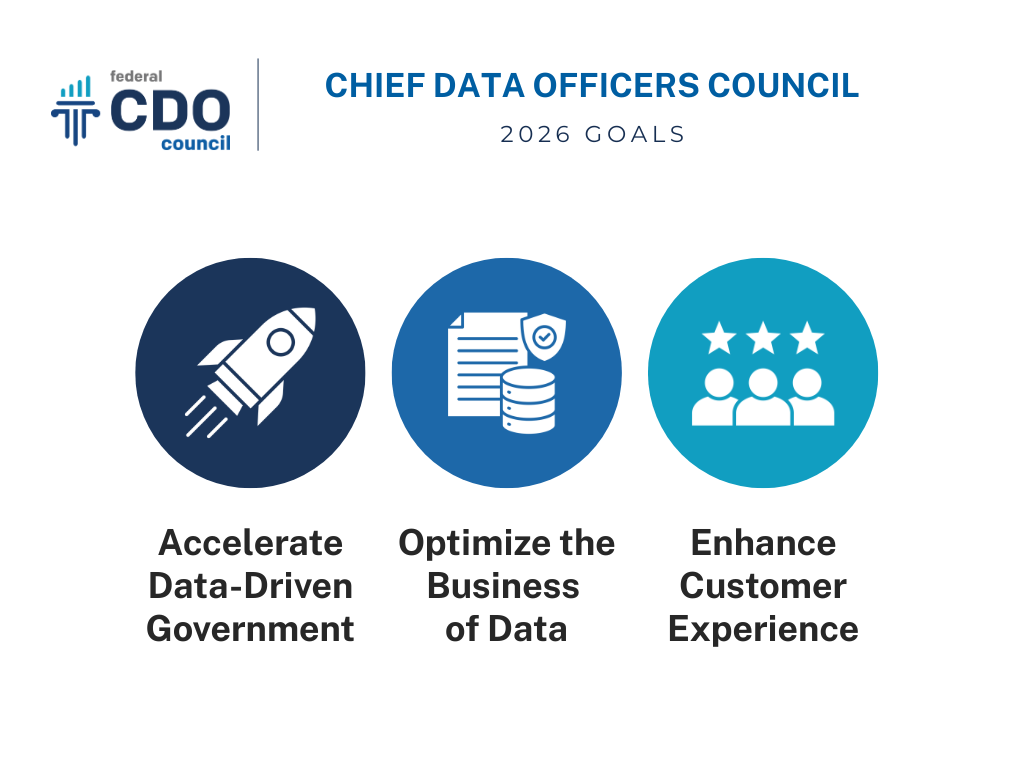
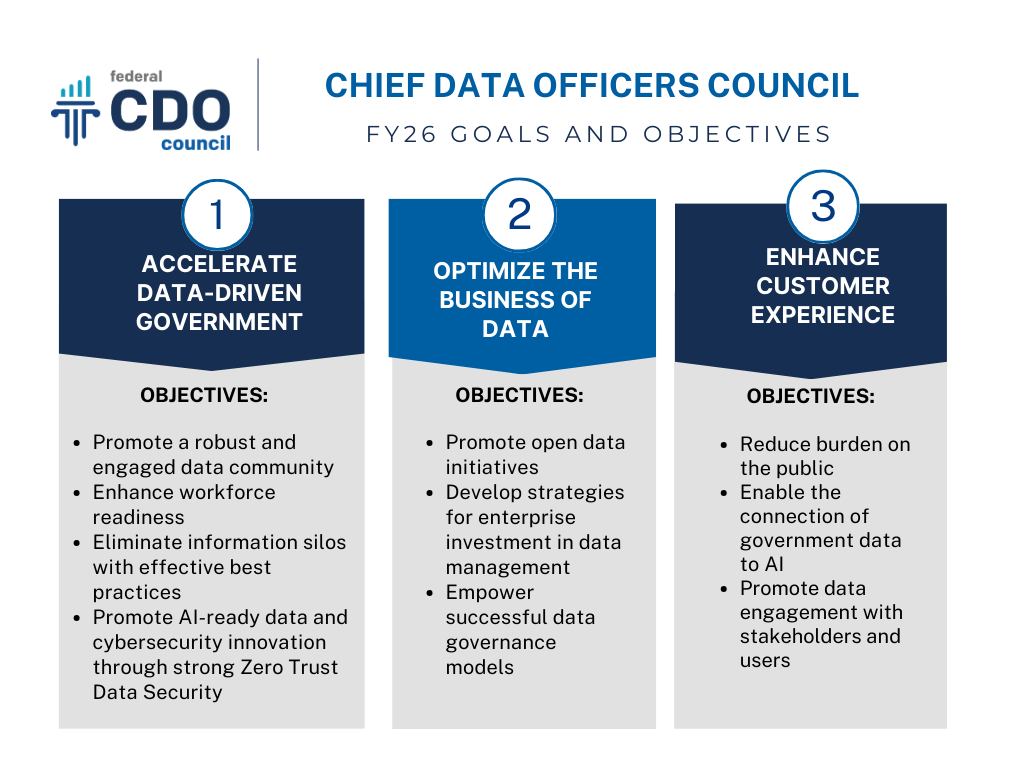
CDO Council Goals and Objectives
Working Groups and Committees
Business of Data Working Group
The Business of Data Working Group is committed to strengthening the value of data as a strategic asset for government operations, innovation, and service delivery. By promoting open data initiatives, the group advances transparency, accessibility, and public engagement while enabling data-driven solutions that benefit both government and society. To maximize the return on investment in data, the group develops strategies for enterprise-level investment in modern data management practices that ensure efficiency, scalability, and long-term sustainability. Additionally, the group empowers agencies to adopt and implement successful data governance models that drive accountability, consistency, and trust in the use of data across the enterprise.
Customer Experience Working Group
The Customer Experience Working Group is dedicated to transforming how the public interacts with government data by making services more accessible, responsive, and user centered. At the heart of this mission is reducing the burden on the public through simplified processes, streamlined service delivery, and a commitment to designing experiences around people's needs. The group also enables the responsible connection of government data to artificial intelligence, unlocking new opportunities to provide faster, smarter, and more personalized services while ensuring trust and accountability. Equally important, the group promotes active engagement with stakeholders and users, ensuring their voices help shape policies, practices, and tools that improve the customer journey.
Data-Driven Government Working Group
The Data-Driven Government Working Group is dedicated to advancing the effective, secure, and innovative use of AI-ready data across the public sector to improve decision-making, strengthen public trust, and deliver better outcomes for citizens. Guided by four core objectives, the group seeks to foster a robust and engaged data community that encourages collaboration, knowledge-sharing, and AI-accelerated innovation. Recognizing the importance of people as the foundation of progress, the group works to enhance workforce readiness by equipping government professionals with the skills, tools, and training needed to thrive in a data-driven environment. To break down barriers to progress, the group promotes strategies and best practices that eliminate information silos and enable seamless, secure, and responsible sharing of AI-ready data across agencies and jurisdictions. Finally, with an unwavering focus on security and resilience, the group supports the advancement of AI-ready data and cybersecurity innovation through the adoption of strong Zero Trust Data Security principles, ensuring that government data remains protected and trusted in an evolving threat landscape.
Small Agency Committee
Develop strategies, solutions, and resources to address and advocate for small agency needs and opportunities in implementing the Foundations for Evidence Based Policymaking Act and Federal Data Strategy to ensure that CDO's at Small Agencies are successful across the data lifecycle.
Large Agency Committee
The Large Agency Committee supports all of the goals of the CDO Council, as appropriate, by ensuring the CDO Council and Executive Committee understand the unique contributions that the 24 CFO Act Agencies can bring to bear and the challenges these large agencies face. The committee offers experimental and innovative opportunities in the Large Agencies to test ideas that further the shared goals of the CDO Council; serves as a collaborative body of Large Agency CDO's to share, learn, and work together; and identifies strategies, solutions, and resource needs of Large Agencies.
CDOC Awards Program
Purpose
To recognize both civilian and military employees of federal agencies that demonstrate innovative data practices to advance government mission achievement and increase the benefits to the Nation through improvement in the management, use, protection, dissemination, and generation of data in government decision-making and operations. Nominations must be made by members of the CDOC and should highlight personnel leading work and noteworthy improvements within the Federal Data community.
Award Categories
- Federal Chief Data Officer Council Distinguished Achievement in Federal Data – Individuals or Teams who make truly exceptional contributions to Federal Data and the use of data in policy-making.
- Federal Chief Data Officer Council Distinguished Federal Data Innovator Award – For the mavericks (individuals or teams) who develop creative and "outside the box" ideas, help design them, and see them through to execution, including interagency collaborations, creative uses of data, interactive analytics products, etc.
- Federal Chief Data Officer Council Data Champion of the Year – For Federal employees, outside of the Agency Data office, who make significant contributions to expanding data activities for their programs or agencies.
- Federal Chief Data Officer Council Excellence in Data Governance – Open to personnel or teams who champion policies, processes, or procedures to enhance data governance throughout the Federal government or between state, local, and tribal governments.
- Federal Chief Data Officer Council Team of the Year – Highlights the achievements of Federal teams who made strides in leveraging data as a strategic asset in or across agencies. For consideration for this award, teams may be composed of personnel within the data community or consist of cross-functional personnel (privacy, evaluation, statistical personnel, etc.).
- Federal Chief Data Officer Council Award Working Group Superior Contributor – For CDOC WG members with superior performance in the execution of WG goals. Selected by WG chair.
Nomination Criteria
Award nominations must be submitted by a CDO Council member and should describe, in an unclassified manner, the challenge and outcomes of the project or team actions. Nominations will be scored based on accomplishment of any of the following:
- Creativity, innovative approach to a data challenge;
- Impact (ie: Saved time, money, resources; increased synergies, collaboration, etc.);
- Impact on Internal and/or External Customer Experience;
- Promotion of Data Culture
Each nomination will be scored on a scale of 1-5 in each for the aforementioned criteria. Nominations must score an average of 3 or higher for selection as a winner in any category.
Eligibility
Only Federal Employees and military personnel are eligible for this program. Each category will allocate up to two awards annually, one for a CFO-Act Agency recipient or team and one for a non-CFO Act Agency recipient or team. Contract staff are ineligible for consideration.
CFO-Act Agencies: This category is open to Chief Data Officers and support staff from any of the 24 Chief Financial Officers (CFO) Act agencies. The 24 CFO Act Agencies include:
- Agency for International Development
- Department of Agriculture
- Department of Commerce
- Department of Defense (including Military Departments)
- Department of Education
- Department of Energy
- Department of Health and Human Services
- Department of Homeland Security
- Department of Housing and Urban Development
- Department of the Interior
- Department of Justice
- Department of Labor
- Department of State
- Department of Transportation
- Department of the Treasury
- Department of Veterans Affairs
- Environmental Protection Agency
- General Services Administration
- National Aeronautics and Space Administration
- National Science Foundation
- Nuclear Regulatory Commission
- Office of Personnel Management
- Small Business Administration
- Social Security Administration
Non-CFO-Act Agencies: Chief Data Officers and support staff from any Non-CFO Act Agency are eligible for consideration.
The CDO Council definition of "Agency" comes from 44 USC 3502. Under the definitions in that section the term Agency means: (1) the term "agency" means any executive department, military department, Government corporation, Government controlled corporation, or other establishment in the executive branch of the Government (including the Executive Office of the President), or any independent regulatory agency, but does not include:
- the Government Accountability Office;
- Federal Election Commission;
- the governments of the District of Columbia and of the territories and possessions of the United States, and their various subdivisions; or
- Government-owned contractor-operated facilities, including laboratories engaged in national defense research and production activities
Award Period
Annual/ Per Calendar Year (1 Jan - 31 Dec)